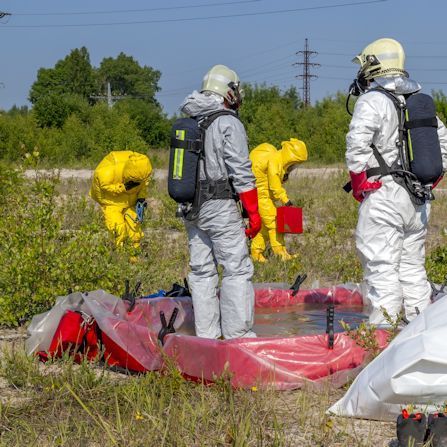
Hazardous Waste Operations and Emergency Response - for General Site Workers

The “HAZWOPER for General Site Workers” training is a 40-hour HAZWOPER certification program based on the requirements established by OSHA Standard 29 CFR 1910.120.
The purpose of the training is to provide participants with the knowledge and practical skills required to work safely with hazardous waste, hazardous chemicals, and contaminated sites. The program covers workplace hazard identification and assessment, risk control, proper use of personal protective equipment (PPE), workplace monitoring, decontamination, and emergency response.
The program consists of 10 core thematic areas, covering topics ranging from hazardous waste management and chemical safety to confined space entry, construction and industrial hazards, and emergency response management.
Program Components
1. HAZWOPER Fundamentals and Safety & Health Program
- The concept, purpose, and key requirements of HAZWOPER;
- Basic safety principles for hazardous waste-related operations;
- Employer and employee responsibilities;
- Planning and organization of the Safety and Health Program;
- Employee training and medical surveillance requirements;
- Basic principles of hazard prevention and control;
- Practical application of HAZWOPER requirements in the workplace.
2. Hazard Identification and Chemical Safety
- Types of workplace hazards and their identification;
- Hierarchy of hazard assessment and control;
- Classification of hazardous substances and hazardous waste;
- Physical and chemical properties of hazardous chemicals;
- Exposure to toxic substances and routes of entry into the body;
- Hazard communication;
- Classification and labeling of hazardous chemicals;
- Use of Safety Data Sheets (SDS);
- Key requirements of the Hazard Communication Standard (HCS) and Globally Harmonized System (GHS).
3. Site Characterization and Workplace Monitoring
- Site Characterization process;
- Preliminary and initial site assessment;
- Hazard identification and assessment;
- Identification and assessment of IDLH conditions;
- Initial and ongoing air monitoring;
- Air sampling methods and equipment;
- Occupational exposure limits;
- Assessment of flammability and explosion risks;
- Interpretation of monitoring results and employee notification.
4. Personal Protective Equipment (PPE)
- Main types and purposes of PPE;
- Selection of the appropriate level of protection;
- Use of chemical protective clothing (CPC);
- Inspection, maintenance, and storage of PPE and CPC;
- A, B, C, and D protection ensembles;
- Permeation, degradation, and penetration;
- Safe practices for PPE use;
- Prevention of heat and cold stress.
5. Site Control and Decontamination
- Key principles of the Site Control Program;
- Establishment and organization of work zones;
- Site access and security control;
- Safe communication and work practices;
- Site Control Maps;
- Development of a Site Decontamination Plan;
- Assessment of physical and chemical contaminants;
- Personnel and equipment decontamination;
- Control of hazards associated with the decontamination process.
6. Confined Space Safety
- Definition and types of confined spaces;
- Permit-Required Confined Spaces;
- Atmospheric and non-atmospheric hazards;
- Oxygen deficiency and toxic/flammable gases;
- Atmospheric testing and monitoring;
- Safe entry and work procedures;
- Evacuation and rescue operations;
- Roles and responsibilities of Entry Attendants and rescue teams;
- Communication and safety requirements for confined space operations.
7. Construction and Industrial Work Safety
- Safe work practices for scaffolds, ladders, and work at height;
- Prevention of slips, trips, and falls;
- Electrical safety;
- Lockout/Tagout (LOTO);
- GFCI and electrical protective devices;
- Excavation and trenching safety;
- Cranes and rigging operations;
- Safe use of powered industrial trucks and heavy equipment;
- Traffic and vehicle movement control at the worksite.
8. Emergency Response and Incident Management
- Basic requirements for emergency response;
- Key HAZMAT activities and responsibilities;
- Incident Command System (ICS);
- Roles and responsibilities within the ICS;
- Communication and coordination during emergencies;
- Management of hazardous materials incidents;
- Decontamination and safety measures;
- Training levels for emergency response personnel.
9. Special Sites and Hazardous Environments
- Safety considerations at Brownfield sites;
- Identification and control of hazards at special sites;
- Safety at clandestine drug laboratory sites;
- Assessment of hazardous substances and contaminated environments;
- Employee protection measures at special sites;
- Practical application of HAZWOPER requirements at various types of sites.
10. Additional Safety Topics and Emergency Management
- Bloodborne pathogens and Other Potentially Infectious Materials (OPIM);
- Key requirements of the Exposure Control Plan;
- Universal Precautions;
- Safe handling of waste drums and containers;
- Safe movement, storage, and disposal of waste;
- OSHA inspection process and employee rights;
- Employer responsibilities during OSHA inspections;
- DOT Emergency Response Guidebook (ERG);
- Use of the ERG during hazardous materials incidents.
Who Is This Training For?
The training is intended for employees who work or may work with hazardous waste, hazardous substances, or at contaminated sites, including:
✅ Hazardous waste management and cleanup personnel;
✅ Employees working at hazardous waste and TSD facilities;
✅ Environmental and occupational health and safety professionals;
✅ Technical and operational personnel;
✅ Employees working with hazardous chemicals;
✅ Emergency response team members;
✅ Personnel working in confined spaces;
✅ Construction and industrial personnel;
✅ Supervisors and managers;
- ✅ Personnel responsible for workplace Safety and Health Programs.
⏱️ Duration: 40 hours
📍 Format: Certification training – theoretical and practical components
📜 Certificate: Issued upon successful completion of the final assessment (examination).